A new study shows mangroves in Florida reduce average annual storm surge losses by $67 million in Collier County, and have provided even greater benefits during major hurricanes—a reduction of $725 million in losses during Irma and $4 billion during Ian.
The Gist
A new study published in Cell Reports Sustainability quantifies the economic value of mangrove forests in reducing property damage from storm surges in Florida. Using high-resolution flood and loss models, researchers found that mangroves in Collier County alone on average reduce annual storm surge losses by $67 million. Nearly three-quarters of these mangrove benefits accrue for storm surge from events with return periods less than 50 years.
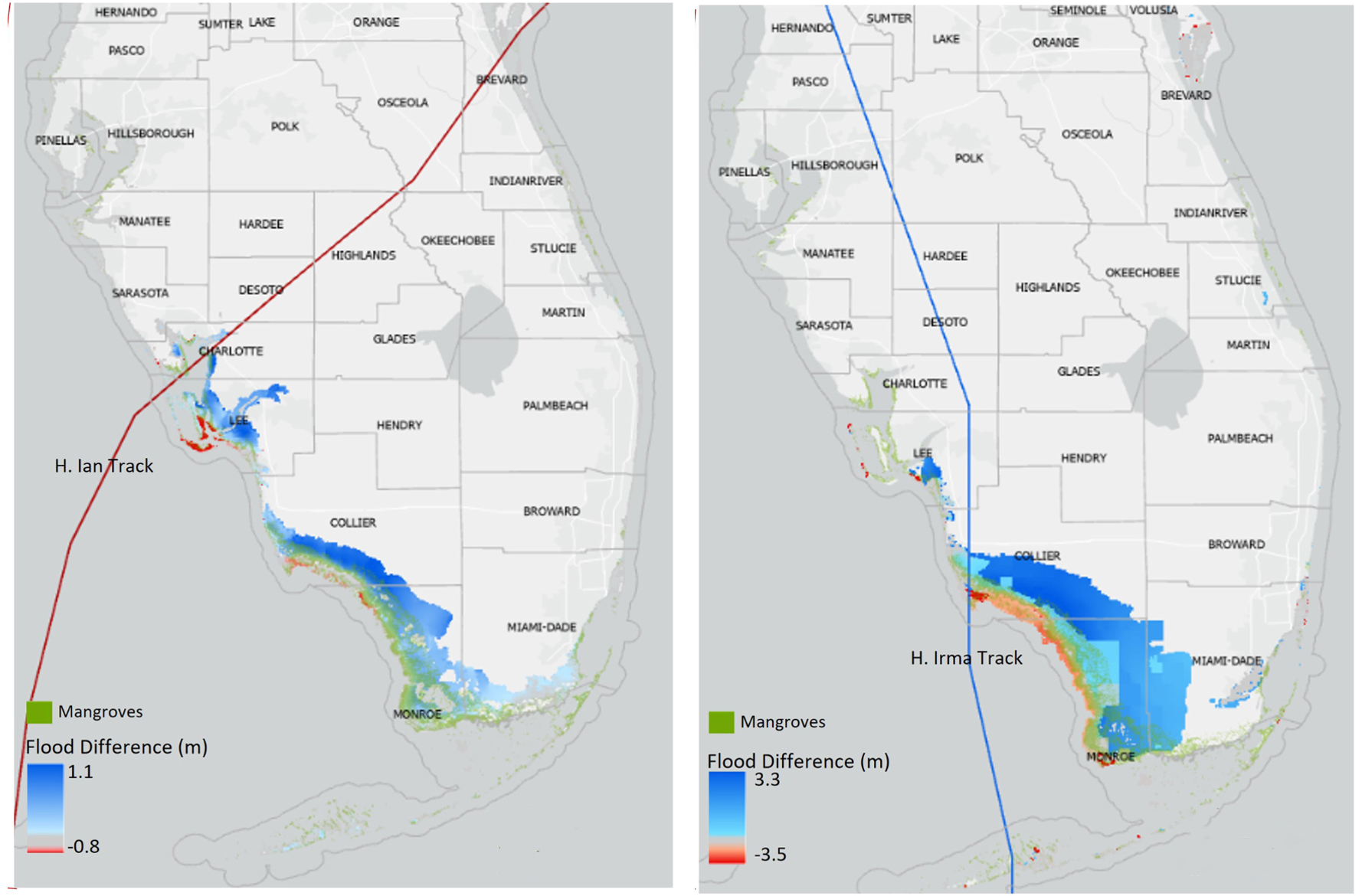
During Hurricane Irma (2017), mangroves reduced damages by $725 million (14%), and during Hurricane Ian (2022), by $4 billion (30%). The study also reveals that landward properties consistently benefit from mangrove protection, and effects on properties inside or seaward of mangrove forests, though hugely net positive, are more variable.
“By assessing the types of storms where mangroves are most beneficial for property loss reduction,” notes lead author Siddharth Narayan, coastal engineer and faculty at East Carolina University, “we can provide evidence to inform public and private investments in the conservation and restoration of mangroves as valuable natural infrastructure for risk reduction.”
The Big Picture
Mangrove forests are increasingly recognized as an important nature-based solution for reducing risk to coastal communities. Florida, with its extensive coastline and high-value coastal properties, is particularly vulnerable to hurricane-driven storm surges. This study advances previous research by modeling mangrove effects at kilometer-scale resolution across multiple storm events, including synthetic storms representing 100,000 years of tropical cyclone activity and reconstructions of Hurricanes Irma and Ian.
Key findings include:
- Location matters: Mangrove benefits are not uniform. Properties landward of mangroves always see reduced damages, while those inside or seaward of mangroves may experience mixed outcomes due to complex hydrodynamic interactions.
- Mangroves are most beneficial for frequent storms: More than half of the annual avoided losses occur during storms with return periods under 30 years—events likely to happen within a typical home mortgage cycle.
- High economic value per area: The annual benefits of $67 million from mangroves in Collier County translate to $270,000 in avoided losses per km² per year for the approximately 250 km2 of mangroves in Collier County in our model.
- Modeling approach: The study uses insurance industry-standard catastrophe risk models, integrating storm surge simulations with property-level damage assessments. This approach allows for fine-scale analysis and supports the inclusion of mangroves in risk reduction strategies and insurance frameworks.
Importantly, the study also highlights that mangrove effects can be conservative estimates, given the modeling assumptions. For example, the friction coefficient used to simulate mangrove resistance to water flow was on the lower end of validated ranges, suggesting actual benefits may be even greater.
The Takeaway
“Mangroves aren’t just beautiful coastal ecosystems—they’re powerful protectors when storms roll in,” says Christine Shepard, Director of Science for TNC’s Gulf Program. “This study makes a strong case for why we should be investing in their conservation and restoration, especially in hurricane-prone places like Florida. The real value of mangroves shows up during frequent, lower-intensity storms, where they consistently reduce property damage.”
The authors note that more than US$100 billion was appropriated by the US federal government to recover from coastal impacts after the 2017 hurricane season, while in south Florida alone, mangroves provided over US$4 billion in avoided damages during the 2017 and 2023 hurricane seasons. Few of these recovery funds have so far been used to restore or to repair the flood-reducing natural infrastructure damaged during these storms.
As climate change fuels stronger storms and coastal development continues, mangroves are becoming even more essential. They’re not just nature’s buffer—they’re natural infrastructure worth serious investment and smart planning.