Sweat runs into my eyes, the heat and humidity stifling even at 10 p.m. A slight breeze provides little relief. Instead, it brings the scent of the decomposing carcasses from two white chickens and two white doves, likely deposited as part of a Santeria ceremony.
I’m standing along a Miami canal, sticky and gross, and happy to be here. I’m joined by Zisko Apaza, a cheerful local angler who shares my enthusiasm for unusual fish in unusual places. And like many canals in South Florida, you never know what exotic species you might find swimming here. Zisko has caught a variety of non-native catfish species and swamp eels. Little did I know, but tonight’s catch would be something even stranger.
We cast out lines baited with shrimp and wait. The rods twitch with a couple of enticing bites, but after a couple of hours, we have yet to land fish. A large alligator drifts in and gulps down one of the decomposing chickens. Feathers drift in the canal.
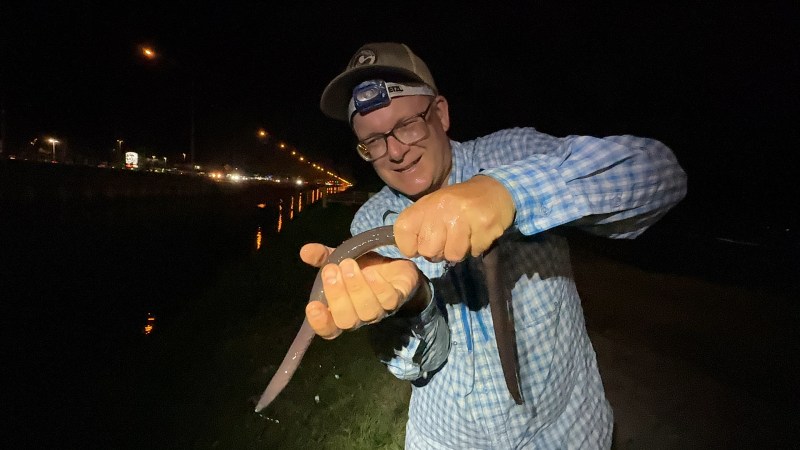
I see one rod make a slight jerk, then nothing. I reel and feel a slight, wiggling tension. It’s hardly a fight, but as I reel I see a wriggling creature, bringing to mind an eel or a snake. It’s neither.
“You caught a caecilian!” Zisko exclaims.
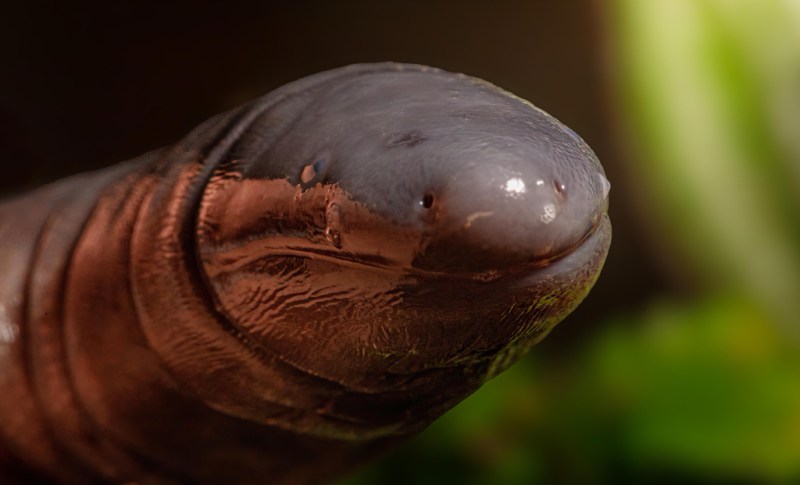
He’s already rushing for an aquarium, filling it with water so we can observe this animal up close. It is legless, with beady, largely non-functioning eyes. It may be the weirdest thing I’ve ever caught. And it’s not even a fish.
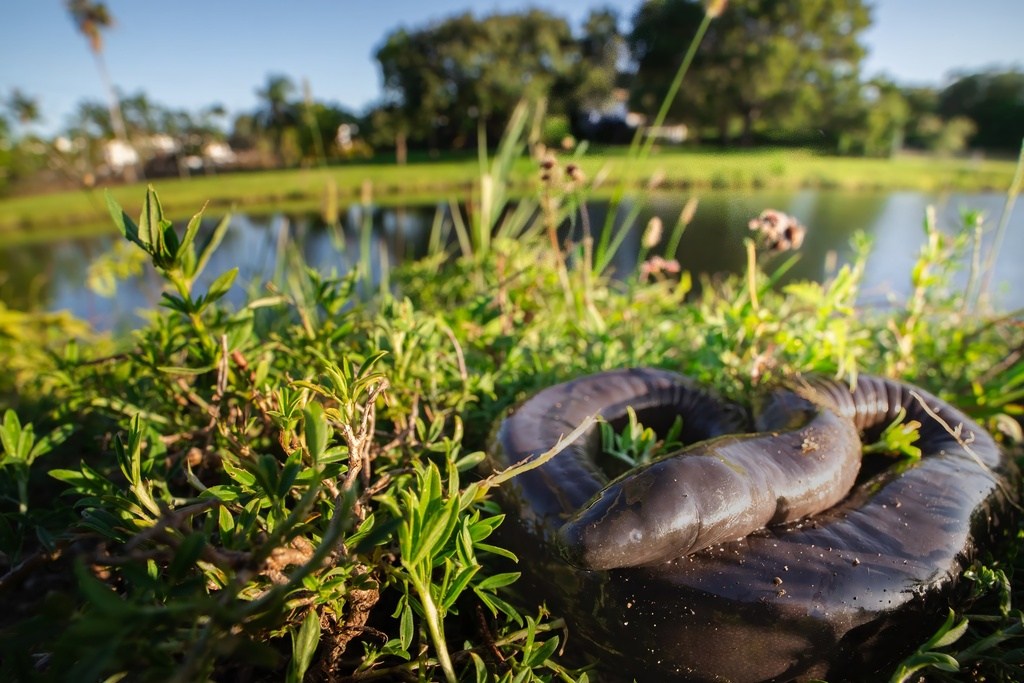
The Rio Cauca caecilian is a little-known amphibian native to river basins in Venezuela and Colombia. It’s now also established in Miami canals.
What exactly is a caecilian? How did it get to Florida? What are its ecological impacts? Let’s look at this unusual creature, what we know about it, and the many questions that remain to be answered.
Meet the Caecilians
There are three taxonomic orders of living amphibians. Two of them, Anura (frogs and toads) and Caudata (salamanders and newts) are familiar. Many of us encounter them in local ponds and in children’s books.
The third order, Gymnophiona, consists of the caecilians. Most of us will not see a caecilian on a walk around the park. Even most professional herpetologists have not encountered one.
“They are by far the least-understood and least-studied amphibians,” says Coleman Sheehy, collection manager of herpetology at the Florida Museum of Natural History. “I’ve done field work all over the world, and I’ve never seen one in its native range. There’s not a lot known about caecilians in general, largely because they are so secretive and hard to find.”
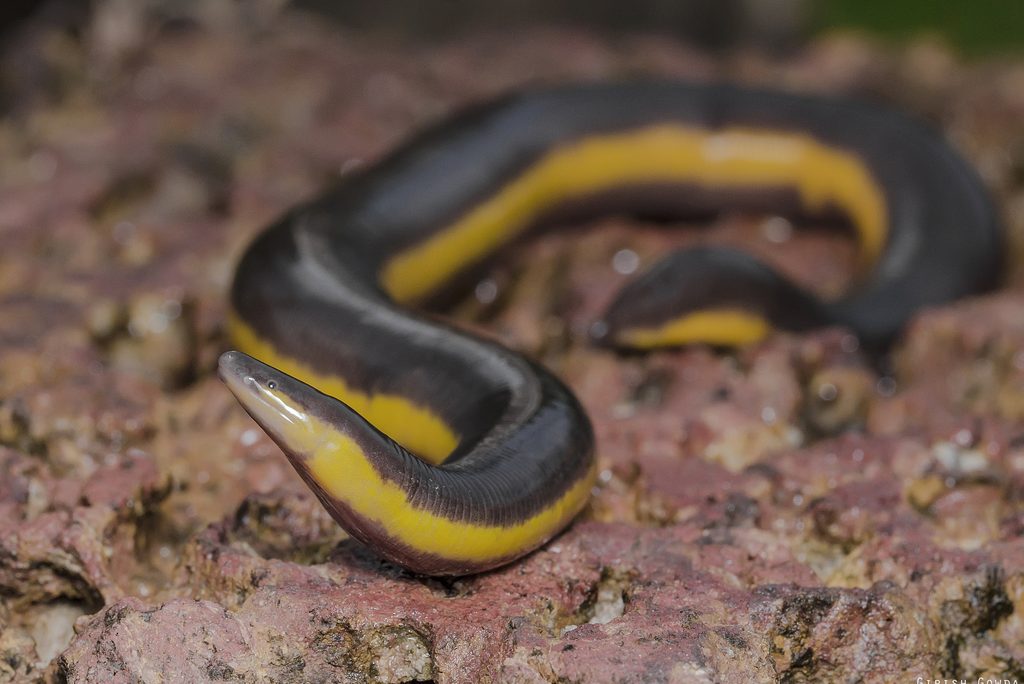
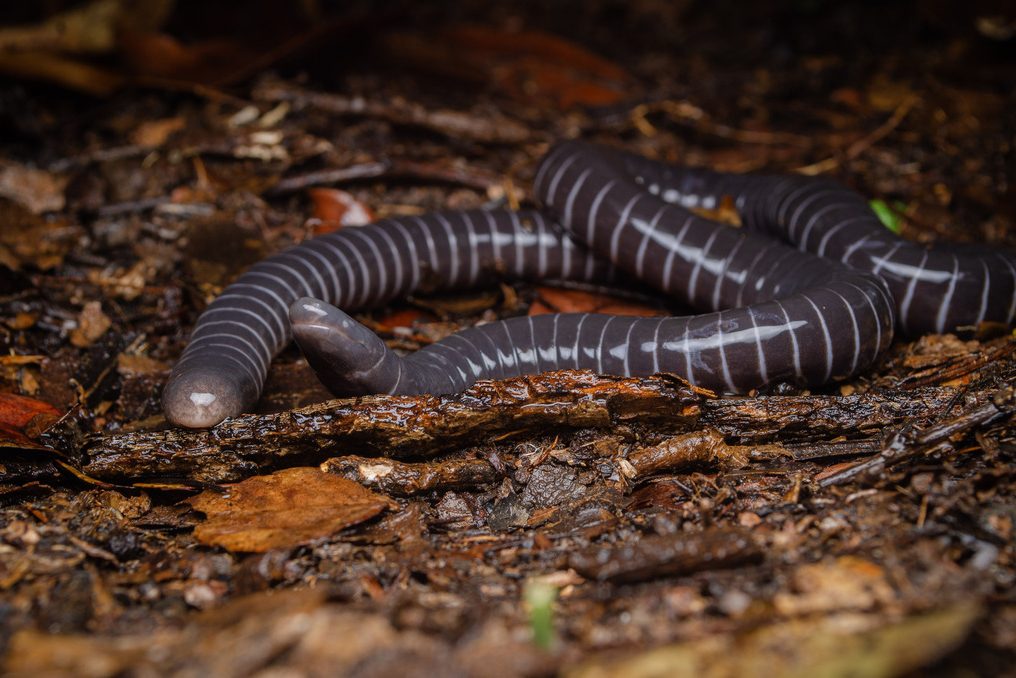
There are more than 200 species of caecilians found in tropical regions of Africa, Asia, Central America and South America. Many are terrestrial animals that live in leaf litter or burrow underground. About 15 South American caecilians, including the species I caught, are aquatic.
A caecilian somewhat resembles a thick rope. A very slimy rope. As I lifted the caecilian into the aquarium, it was almost impossible to grasp.
Caecilians are limbless and have limited eyesight, and have a tentacle between their eye and nostril that serves as a sensory organ. “Only caecilians have this organ,” says Sheehy.
The caecilian species now found in Florida gives birth to live young. “Some caecilians are believed to give extensive maternal care,” says Sheehy.
That maternal care is also a bit weird, at least by human standards. Some baby caecilians scrape at their mother with specialized baby teeth, eating a fatty secretion on her skin. Other caecilian species feed their young with a milk-like secretion that is released and consumed at their cloaca.
Because they are difficult to find in the wild, there is still a lot that is not known about caecilians. “Some species are known from only one specimen,” says Sheehy. “We don’t know some basic aspects of their biology, because we’re limited by small sample sizes. Procuring large sample sizes is unheard of.”
Well, at least until now. That’s because one species of caecilian is now found in Miami canals, and it appears they’re thriving.
An Unexpected Amphibian
In conservation circles, South Florida is known for a seemingly never-ending array of non-native and invasive species. The combination of warm climate, lots of imports and lots of exotic pets create a perfect storm for new species introductions.
Burmese pythons have gained particular notoriety for devastating mammal populations in the Everglades. Walk around a park in South Florida and you can see various parakeets flying overhead, Egyptian ducks swimming in ponds and even monkeys jumping through trees.
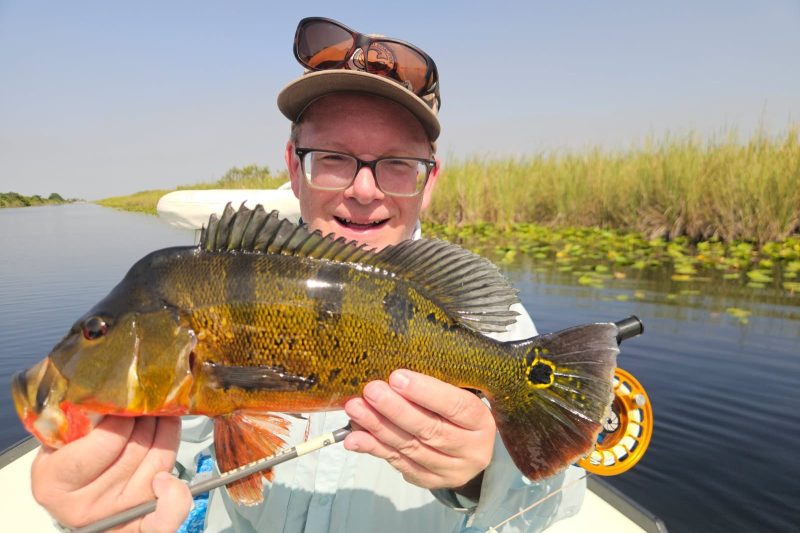
Underwater, the exotic species may be even more surprising. There are walking catfish that have been documented foraging worms in parking lots. I’ve caught bullseye snakeheads and clown knifefish and peacock bass.
Coleman Sheehy knows the negative potential for non-native species in Florida. Still, the caecilian caught him unaware. “I don’t think any species was more surprising to find here than caecilians,” he says.
In 2019, a U.S. Fish and Wildlife Service sampling crew caught a caecilian in a Miami canal. The crew sent the specimen to Sheehy, who identified it as a Rio Cauca caecilian.
“I thought it was unlikely it was the only one there,” says Sheehy.
He searched social media and saw that some anglers had caught them, including my friend Zisko Apaza. Sheehy organized a trip to Miami canals to assess the presence of this unexpected amphibian.
“I thought, let’s put traps out and see what we can find,” he says.
At first, they didn’t find much. As amphibians, caecilians need to come up for air periodically. Sheehy figured that meant they’d be found in the shallows. But traps placed there came up empty.
The team then put traps, baited with Vienna sausages, in the deepest part of the canal. As Sheehy pulled a trap in, he could barely pull it. “I thought the trap was snagged. I was disappointed I lost it,” he says.
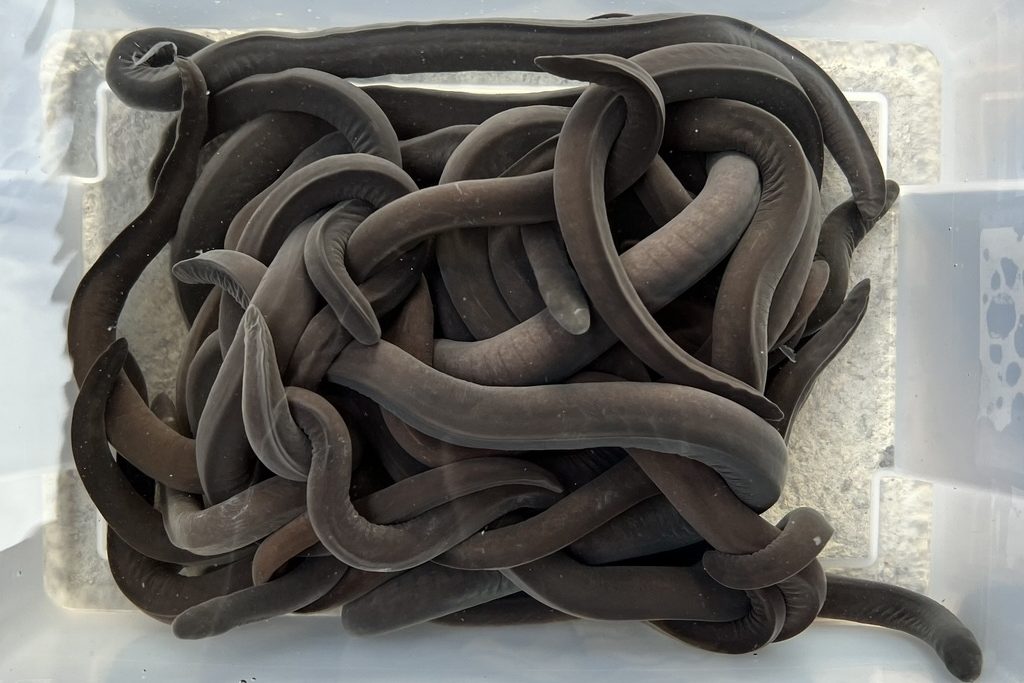
But he was able to pull the trap, but it was still heavy. He now was convinced it had become covered in aquatic vegetation.
“As I pulled the trap to the top, there was no vegetation on it,” Sheehy says. “The trap was filled to the brim with caecilians. We had caught 48 caecilians.”
Depending on your perspective, this is the stuff of nightmare fuel. Or, if you’re a herpetologist, it might evoke conflicting emotions.
“It’s never good to find a new non-native species, of course,” says Sheehy. “But there’s also fascination. This is a really unusual one. If this species is here and accessible, and all we need to get specimens is a freshwater fishing license, we can learn a lot about them.”
Sheehy was lead author of a paper announcing the establishment of the Rio Cauca caecilian in Florida. But there are still more questions than answers as to what this means.
Caecilians in Florida
How did caecilians end up in Miami canals? There’s no definitive answer. They are in the pet trade, and many animal populations now roaming Florida originated as released or escaped pets.
“Caecilians were never a common pet,” says Sheehy. “I can see scenarios where someone released their pets.”
For Sheehy and others, the bigger questions surround the impacts that these caecilians pose. Right now, they don’t even know the full distribution of the caecilians. They are definitely established in some Miami canals.
“My suspicion is that they’ve been in these Miami canals for a long time,” Sheehy says. “I wouldn’t be surprised if they were in the Everglades already. But they may not be. They may just be found in certain canals.”
The Rio Cauca caecilians appear to prefer to eat vertebrate carrion, like dead fish. “They don’t seem to bother live fish,” Sheehy says. “As soon as a fish dies, they are on the carcass.”
It remains unclear what, if any, ecological impacts this non-native amphibian could have. “We just don’t know,” says Sheehy. “We don’t know if they’re eating native species, or if native species are eating them. We don’t know if they’re competing with other amphibians. We don’t know any of that. There are lots of questions to answer.”
Sheehy continues to document the occurrence and distributions of new non-native introductions. At the same time, he sees an opportunity with caecilians. “They are weird animals and we just don’t know much about them,” he says. “We have the chance to learn a lot more now.”


Join the Discussion