Migration is perhaps one of the most well-recognized phenomena of the natural world. From the wildebeest traversing your television screen in wildlife documentaries, to the warblers in your backyard, we’ve always been fascinated by animals on the move.
Tens of thousands of years ago, knowledge about the movement of animals would have been critical to our own species’s survival. Today we can simply sit back and wonder at the spectacle.
But not all migrations are obvious. Some happen under the cover of night, thousands of feet below the ocean’s surface. Some are herculean feats of endurance, while others are small – but no less significant – journeys. And some are only just being understood by scientists, especially those undertaken by small and cryptic species.
But no matter the distance traveled, terrain traversed, or the species undertaking the journey, all of these migrations have one thing in common. They’re about survival. Animals following food resources, seeking fair weather, or finding a safe place to raise the next generation.
Read on to learn about eight of the animal world’s little-known migrations, from zooplankton navigating the ocean’s depths, to mole salamanders waddling through the woods, to colorful Australian parrots in peril.
Top 10 List
-
Christmas Island Red Crabs
Gecarcoidea natalis
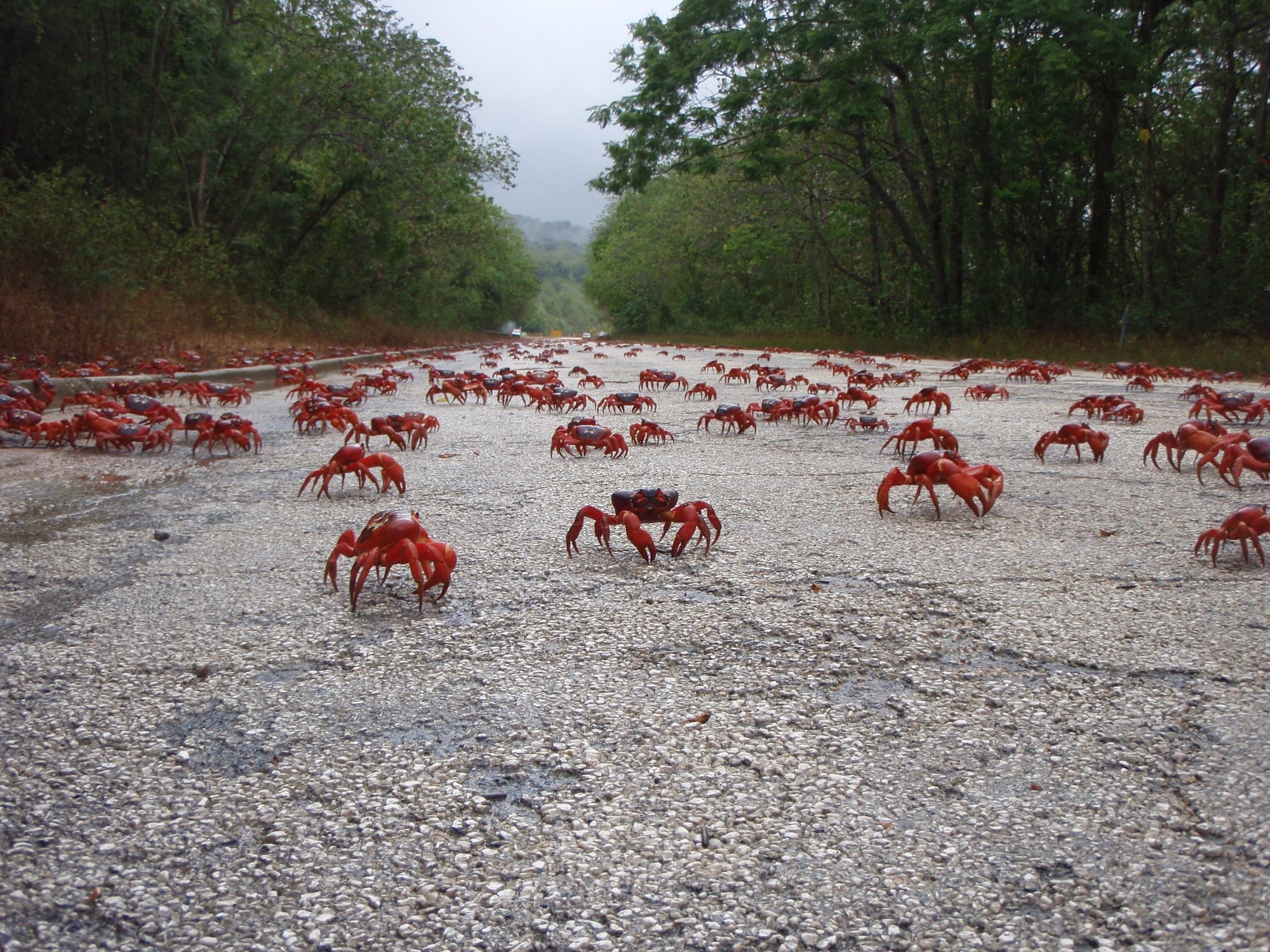
Red crabs swarm the roads on Christmas Island. ©Dion Maple / iNaturalist Each austral summer, Christmas Island is engulfed by a red tidal wave. This small island, located 200 kilometers south-south-west of Jakarta, is home to the spectacular red crab migration, where hundreds of millions of arthropods migrate from the forest to the oceans to breed.
Males migrate first, swarming across roads, inundating streams, and flooding neighborhoods as they make their way to the shore and dig burrows in the sand. Females follow soon after. Once mating is finished, the males return to the forest, while the females gestate their young in the burrows. Eventually, the females travel en-mass to the ocean to deposit the eggs, in coordinated spawning events. About three weeks later, the miniscule baby red crabs emerge from the waves, and march inland.
The timing and speed of the migrations are determined by rainfall, tides and moon phases. The crabs won’t depart their burrows until the first rains fall, and the females will only spawn before dawn, on a receding high-tide, during the last quarter of the moon. The masses of crabs are so great that road closures are common across the island, with the local radio providing regular updates about crab movements.
Red crabs are keystone species on Christmas Island. They keep the forests healthy by consuming plants, reducing leaf litter, turning over the soil with their burrows, and fertilising the forest with their excrement. You can visit the Christmas Island National Park website to learn more about this incredible migration.
-
Common Green Darner Dragonflies
Anax junius
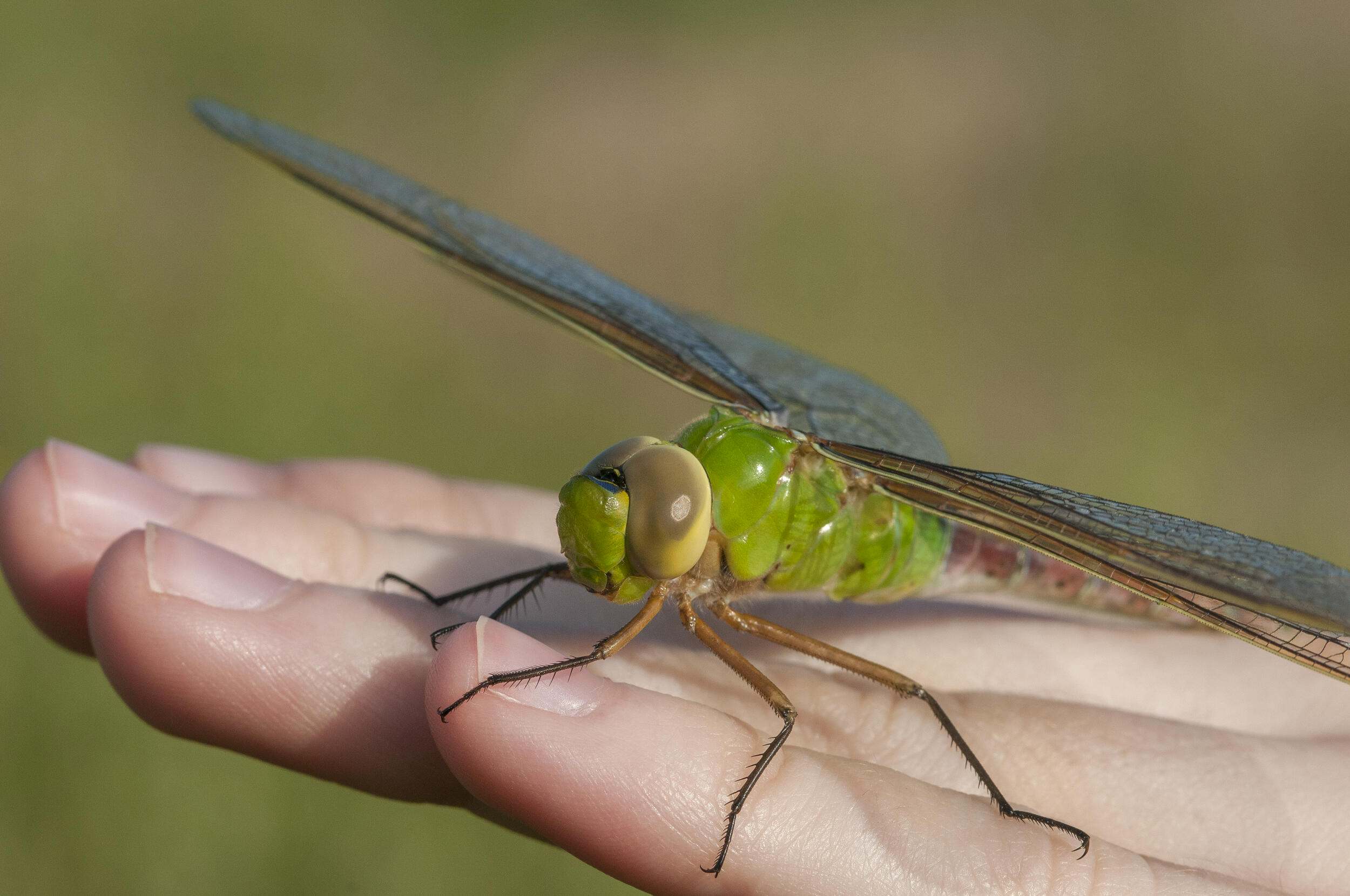
Hand holding a recently emerged green darner dragonfly in the pond/wetland at the Helzer family prairie south of Aurora, Nebraska. © Chris Helzer/TNC With a wingspan barely three inches across and an abdomen that resembles (apparently) a darning needle, the common green darner dragonfly is one of North America’s most abundant dragonflies. Males sport bright blue abdomens and emerald green thoraxes, making them easy to spot as they flit around ponds, rivers and wetlands from Canada to Mexico.
If you didn’t know that many dragonflies are migratory, you’re not alone. In the case of green darners, some populations are resident, meaning they are born, live and die largely in the same location. But some populations migrate, sometimes journeying long distances from Canada to Mexico. But there’s a catch for these travelers. It takes three generations of green darners to complete one migration cycle. It’s an intricacy of nature that wasn’t unraveled until 2018.
Tracking Migrations
Eight innovative ways scientists are mapping migrations to make smarter conservation decisions.
The breakthrough came from Smithsonian researchers who pieced together 140 years of museum specimens, citizen science data, and some clever chemical detective work. By analyzing hydrogen isotopes in dragonfly wings—essentially reading each insect’s geographic fingerprint—they discovered something remarkable: green darners use a three-generation relay system to complete their annual migration. One generation flies north in spring, another heads south in fall, and a third overwinters in southern regions. Temperature around 48°F seems to trigger both emergence and migration.
That apparent temperature dependence has scientists’ attention. With climate change, dragonflies could migrate north earlier and linger later in fall, scrambling their carefully timed life cycle. And while green darners aren’t currently considered threatened, understanding their biology matters. Insects drive entire food webs. And as insect populations plummet globally, unraveling these kinds of complex migration patterns can help scientists identify why populations decline and protect the ecosystems that depend on them.
-
Saiga
Saiga tatarica
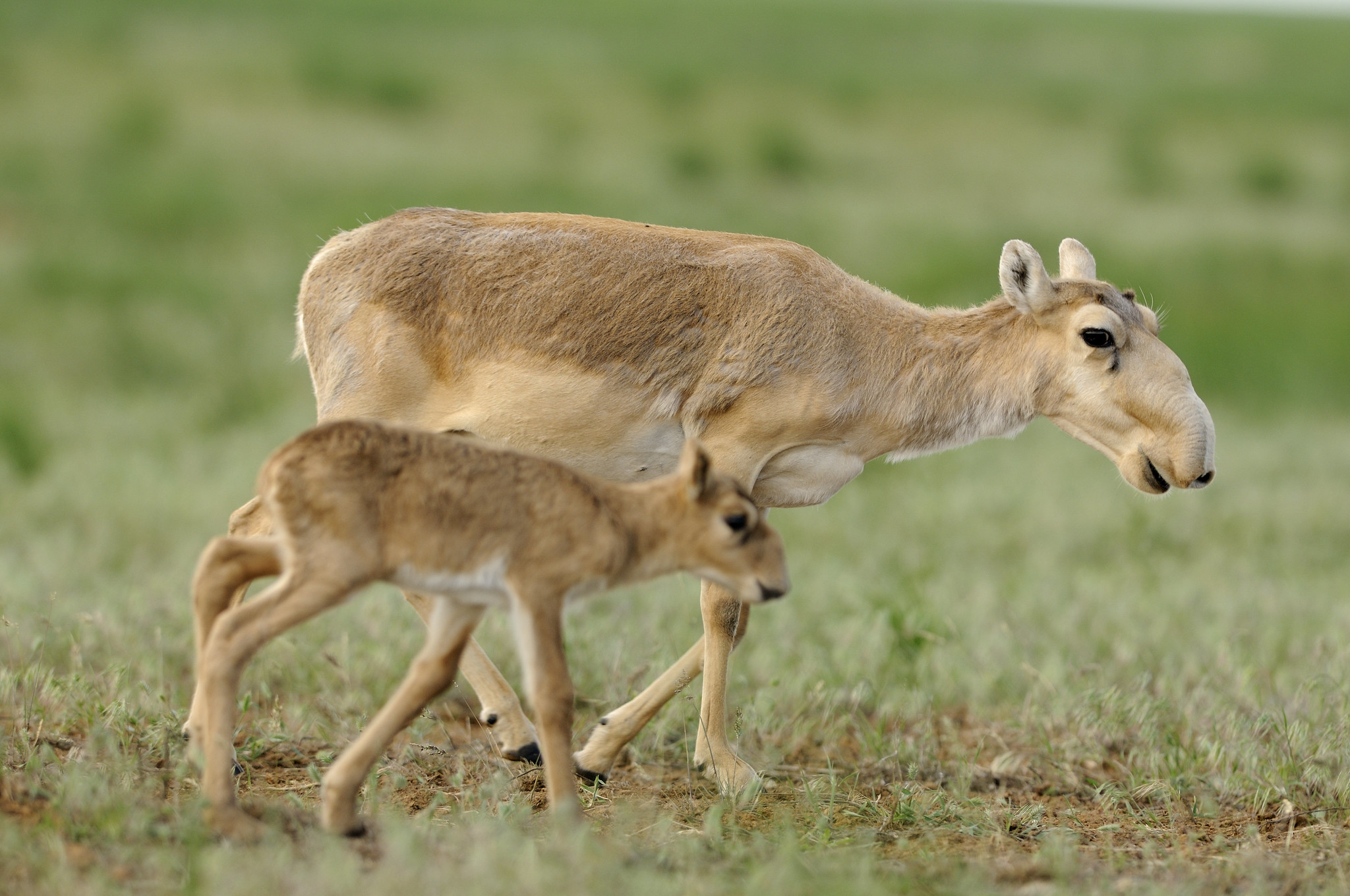
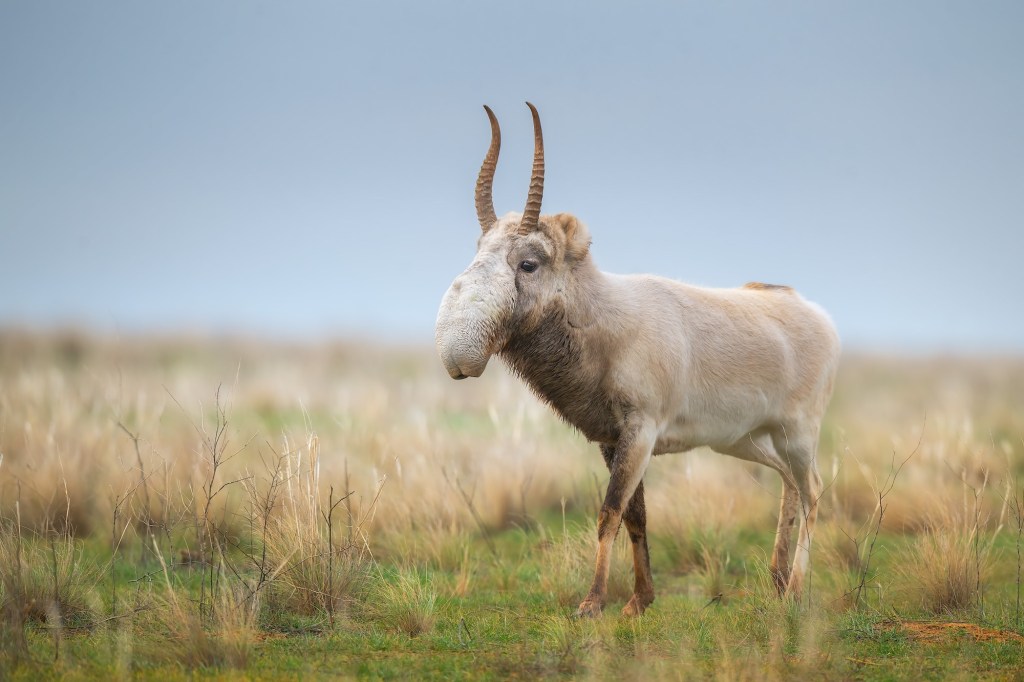
Mother saiga and calf in the steppe in Cherniye Zemly (Black Earth) Nature Reserve, Kalmykia, Russia. © Igor Shpilenok / Flickr The saiga resembles an antelope designed by Dr. Seuss, with its most notable feature a super-sized nose. It turns out that schnoz is superbly adapted for migration in a tough environment.
The goat-sized saiga can migrate 600 miles or more across the Central Asian steppe. In the summer, large herds of saiga kick up a lot of dust, and the big nose serves as a filter. In the winter, the nose heats frigid air before it enters the saiga’s lungs.
Like many migrating hoofed mammals, saiga face significant challenges in a world of human development. Poaching and unsustainable hunting intensified following the fall of the Soviet Union, caused population numbers to decrease by more than 90 percent.
More recently, saiga have contracted livestock diseases, particularly when the animals concentrate on calving grounds in Mongolia.
But there’s good news. In Kazakhstan, the creation of large protected areas, with well-funded enforcement, has resulted in a dramatic population increase. In 2025, saiga numbers surged to an estimated 4.1 million animals.
-
Dusky Grouse
Dendragapus obscurus
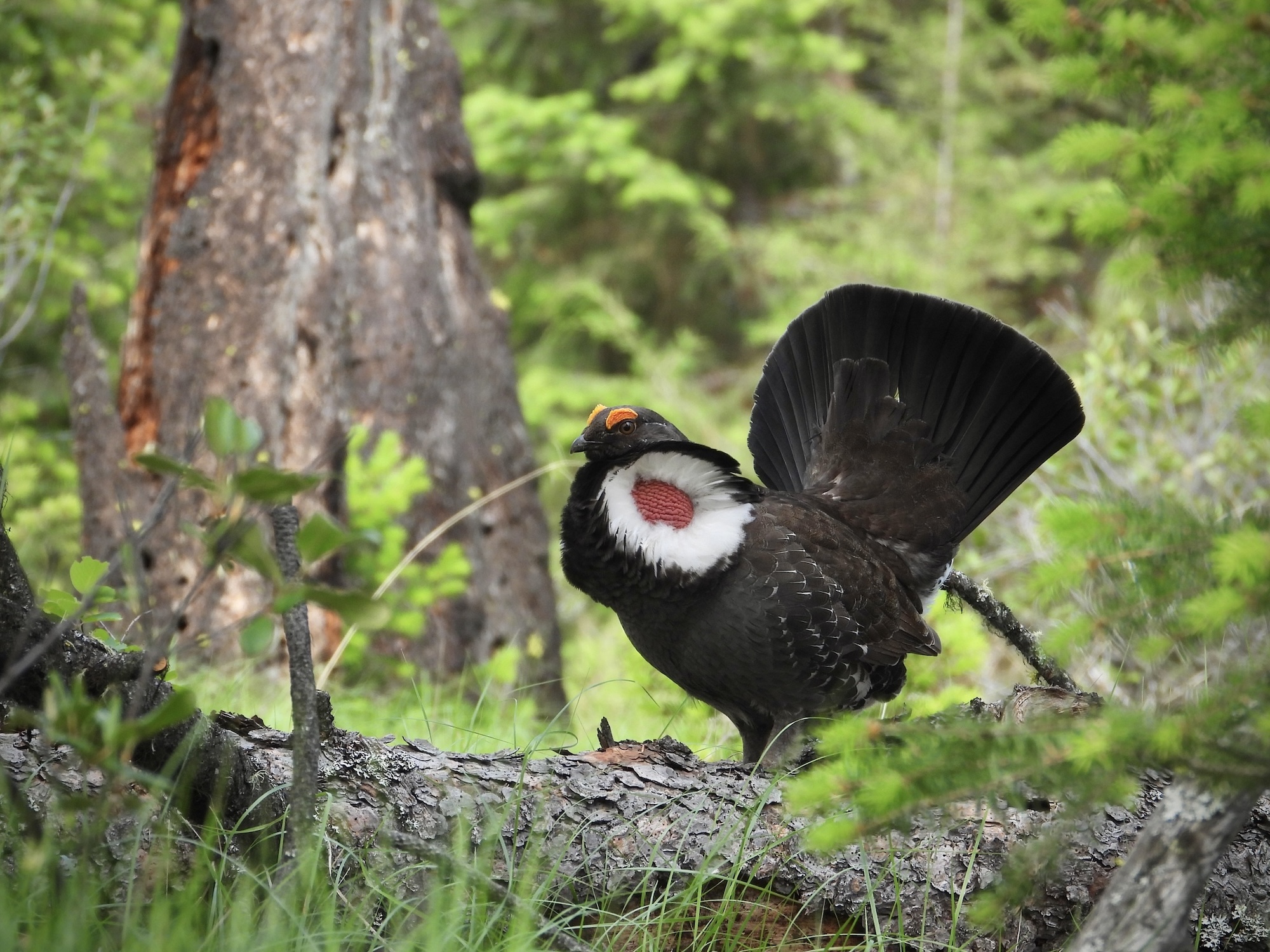
Bird migrations generally move away from cold, ice and snow. But dusky grouse do the reverse. These birds spend summers in hot sagebrush flats and foothills. Come winter, they migrate to heavy snows and high altitudes.
These grouse are found in the Rocky Mountains and Canada, where winters are harsh. Snow on the mountain bury food for most wildlife. But the grouse migrate to this habitat, where they’ll live in the boughs of pine trees.
While their summer diet is diverse, in winter they’ll exclusively dine on pine and fir needles (and only the outer two-thirds of the needles).
Why would an animal move to snowy and harsh conditions? It’s likely to avoid competition. Lots of species take refuge in the valleys and foothills, and they compete for precious calories to survive the winter. In the high mountains, dusky grouse have an untapped nutritional source pretty much to themselves.
-
Zooplankton (Yes, Plankton)
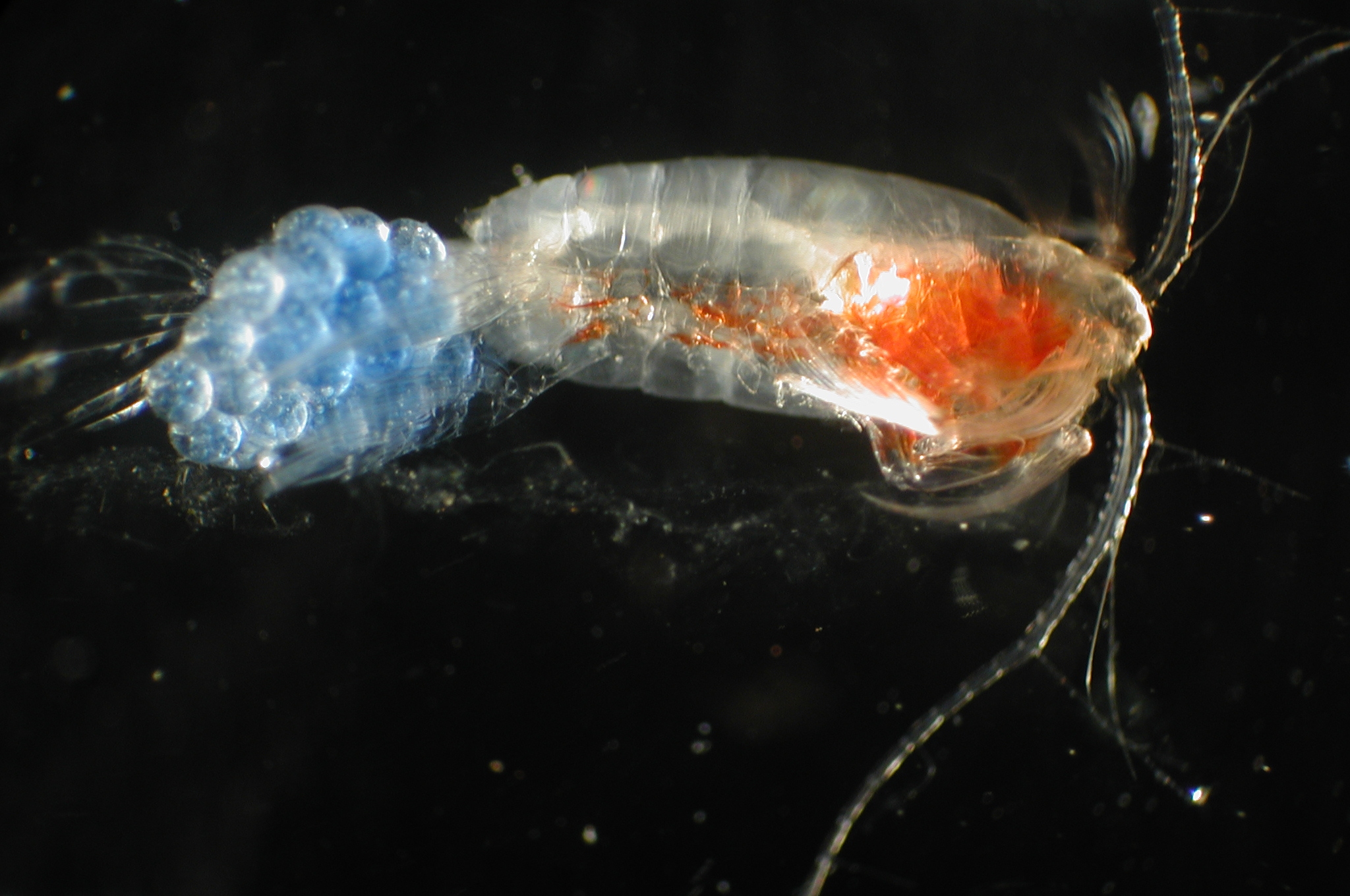
Zooplankton (specifically, a copepod) with eggs seen under a microscope © Matt Wilson/Jay Clark, NOAA NMFS AFSC The largest migration on Earth happens every day and most people have never heard of it. The thing is, migratory movement isn’t just about north to south, or wet to dry, and back again. It is also often about light, temperature, altitude, or in the case of the world’s marine zooplankton, depth.
Every evening, as sunlight fades from the ocean’s surface, trillions of zooplankton—tiny animals often smaller than a grain of rice—begin an extraordinary movement. Throughout the day, zooplankton such as copepods and krill hide hundreds to thousands of feet deep, tucked safely in the ocean’s dim twilight zone. But as darkness spreads, they rise en masse toward the surface and feast on phytoplankton under the cover of night. This nightly ascent, called diel vertical migration, is the largest daily movement of life on Earth.
Some of them are known to travel more than 3,000 feet, and it is not an easy journey. As noted in Scientific American, for quarter-inch fish larva, making a one-way vertical trip of 1,000 feet is the equivalent of a human swimming more than 50 miles—in just an hour or so.
And all of those tiny animals aren’t traveling alone. Lanternfish, squid, jellyfish, and siphonophores join the nightly commute; some hunting the zooplankton, others avoiding their own predators. Scientists are just beginning to understand the intricacies and reasons for such vast movements. Current estimates suggest some 10 billion tons of animals make this journey daily.
This dramatic up‑and‑down movement isn’t just about dinner—it is, like all migrations—about survival. Near the surface during daylight, zooplankton would be easy targets for fish, squid and other visual predators. By feeding and digesting their meals in warmer waters at night, and returning to deeper, cooler waters by day, the zooplankton (and other animals that are part of this journey) may also conserve energy.
Along the way, zooplankton play a surprisingly big role in shaping our planet. After eating at the surface, zooplankton carry carbon downward in their bodies and waste as they sink again, helping lock carbon in the deep ocean for centuries. This “biological pump” influences marine food webs and even Earth’s climate. It’s an astonishing feat for such tiny creatures—an underwater rush hour that happens every single night, all around the globe.
-
Bogong Moth
Agrotis infusa
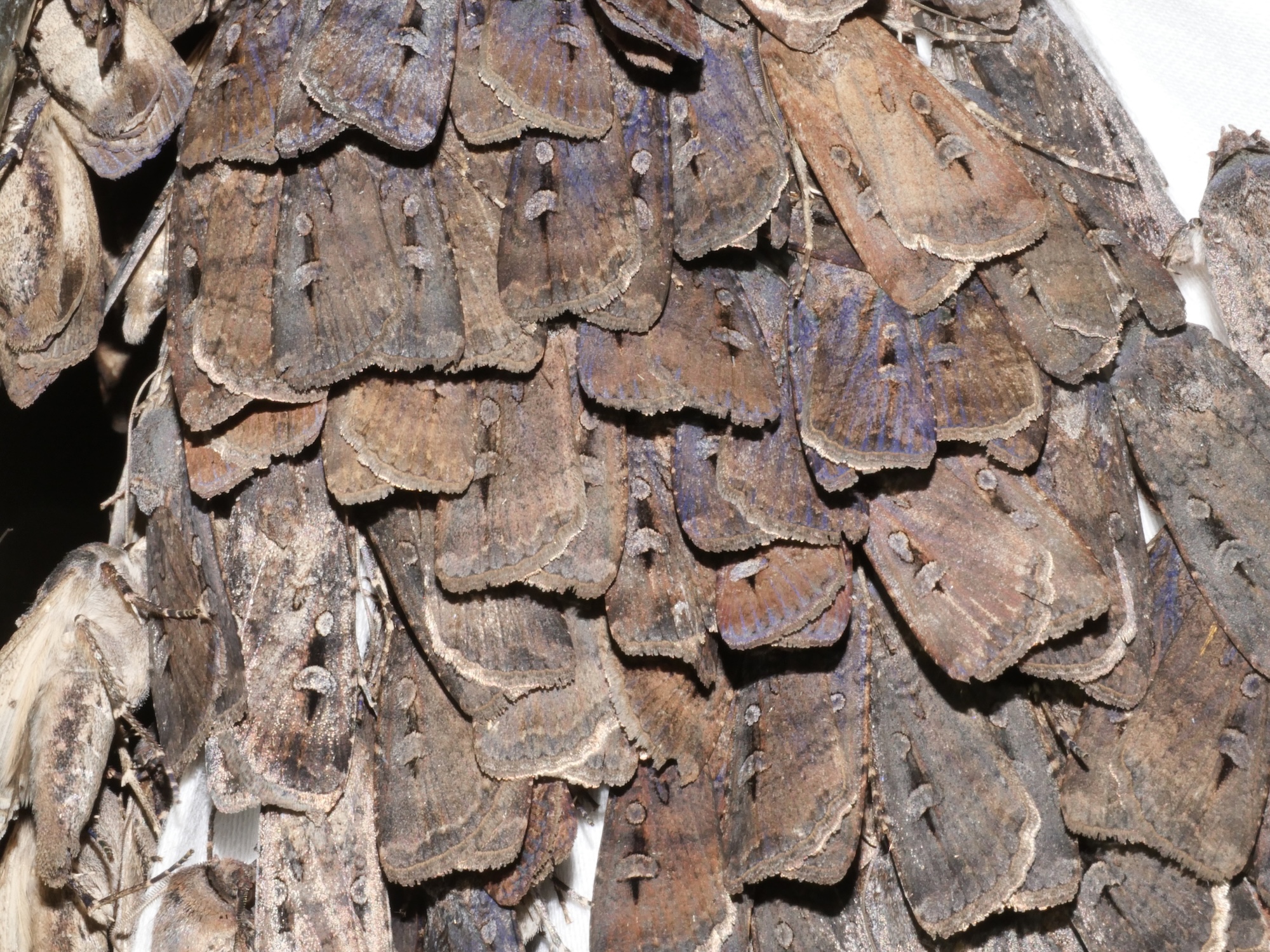
Bogong moths wait out the summer heat in high-alpine caves.© kallies / iNaturalist While green darner dragonflies undertake multi-generational migrations, Australia’s bogong moth performs a different sort of migratory feat. These small, nondescript insects migrate from a broad winter range — agricultural lands in Murray Darling basin — to a handful of high mountain peaks in the Australian Alps. Bogong moths are one of only two known insect species — the other being the monarch butterfly — to exhibit this broad-to-specific location migration pattern.
The moths begin their journey in spring, flying by night and navigating using a celestial compass to navigate distances of more than 1,000 kilometres. Once they arrive at the mountains, they amass in staging areas in the foothills before ascending to the peaks. There, they crawl beneath boulder fields and into small, rock caves, piing in top of one another to reach densities of up to 17,00- moths per square meter. The moths then enter a state of summer hibernation — called aestivation — and wait out the sweltering temperatures safe in their cool, shaded caves.
Dozens of alpine species depend upon these fat-rich insects for survival, with species like guthega skink, currawong, raven, and the endangered mountain pygmy possum all feasting on moths throughout the summer.
A decade ago, scientists estimated the bogong moth population to be around 4 billion animals. But following the most severe drought in recorded history, in 2017, the bogong moth population collapsed by more than 99.5%. For two summers, most aestivation caves were empty, while others sheltered single-digit numbers of moths. The collapse was a catastrophe for other species, especially the mountain pygmy possum.
In the years since, the moth population is slowly recovering. But it’s a grim reminder that even incredibly numerous species aren’t safe from a world turned upside down by climate change.
-
Mole Salamanders
Ambystomatidae
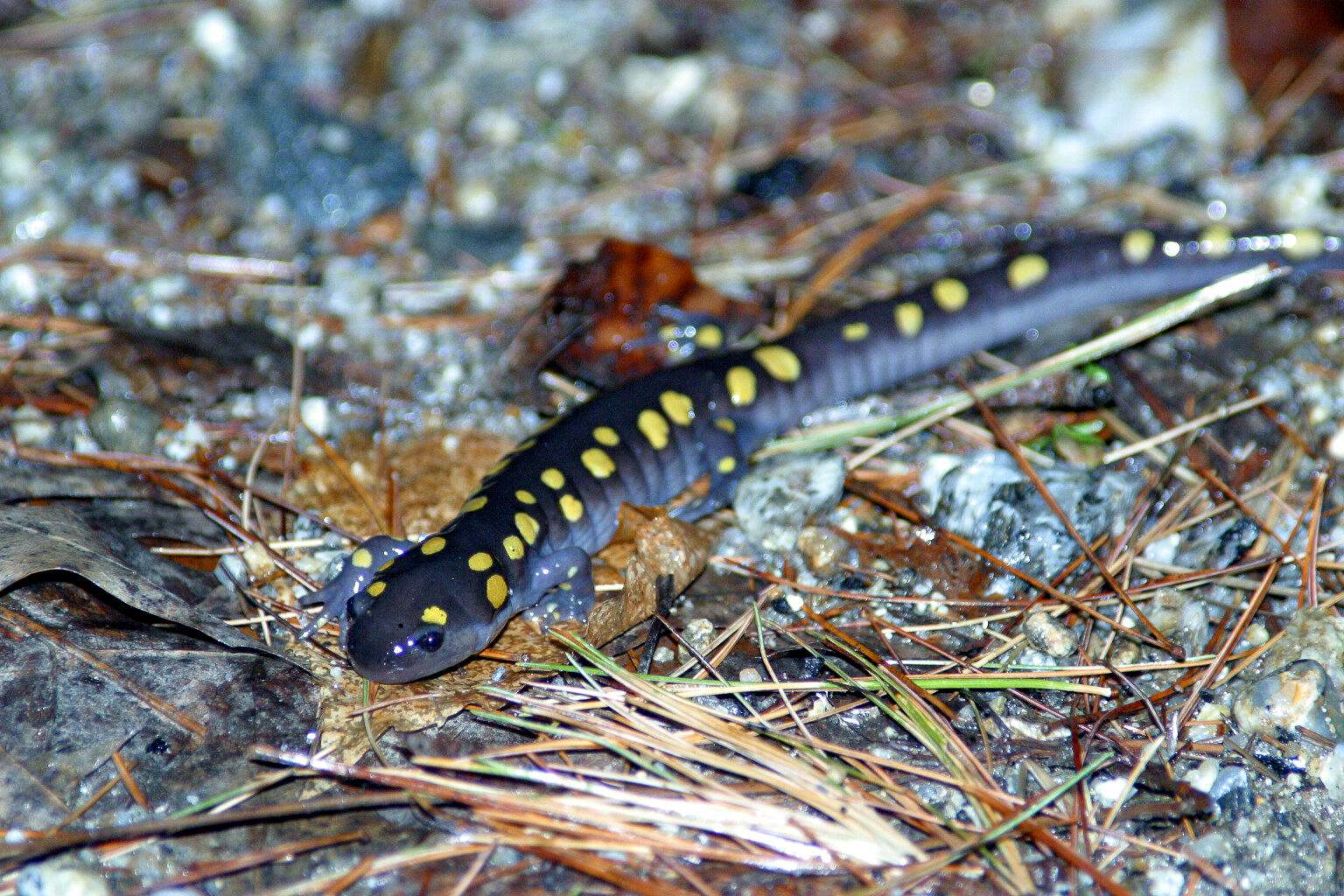
A spotted salamander makes it way across the forest floor in New Hampshire. © Eric Aldrich/TNC Salamanders. They’re fascinating and complicated. Really complicated. So we’re going to stick with the basics here. The short version is: salamanders can be found all over the world, but the US is believed to have the most salamander species.
Among those is a family of salamanders known as mole salamanders, and some mole salamanders, including tiger salamanders and spotted salamanders, migrate.
Mole salamanders of the genus Ambystoma spend most of the year concealed underground, emerging for migration on the first warm, rainy nights of late winter or early spring. During these “Big Night” events, they navigate using a mix of environmental cues: moisture gradients, temperature shifts, geomagnetic orientation, and especially chemical cues in the landscape. Experiments show that many species can detect and follow the scent signature of their home wetlands, helping guide them through the dark forest.
Adults typically migrate hundreds of meters to ephemeral vernal pools, where they court and lay eggs on submerged vegetation. Most Ambystoma species show strong natal philopatry, meaning they usually return to the same pools where they hatched, provided those pools still exist. After larvae develop and metamorphose, juveniles disperse into the surrounding forest, living underground for several years before joining the same astonishing, rain‑soaked migration cycles.
Many local organizations have “Big Night” events to help celebrate and protect salamanders as they make their journey. Check local Facebook pages and TNC’s Events Page for ways to experience nature near you, salamanders sometimes included.
-
Orange-bellied Parrots & Swift Parrots
Neophema chrysogaster & Lathamus discolor

Orange-bellied parrots are one of only two migratory parrot species. ©Tom Hunt / iNaturalist Birds are famous for their epic migrations, from shorebirds that travel from Alaska to Tasmania, or warblers that nest in the high Arctic and overwinter in the tropical rainforests. But what you might not know is that only two of the world’s parrot species are known to migrate. Both live in Australia, and both are critically endangered.
Orange-bellied parrots breed in only one location in Tasmania’s far south, a remote forest surrounded by buttongrass moors. Here, chicks are incubated and hatched high in tree hollows. Once summer ends, both adults and newly-fledged juveniles migrate north to the Australian mainland, where they overwinter in coastal heath and marshlands in Victoria and South Australia.
In 2016, habitat loss had caused the population to drop to a mere 17 birds. In the following 20 years, a robust captive breeding program (with captive-to-wild releases) and intensive monitoring at their nesting site has seen the population grow to about 80 birds. But the situation is still dire. Genetic diversity is perilously low, and the population cannot survive at this stage without the captive breeding program.
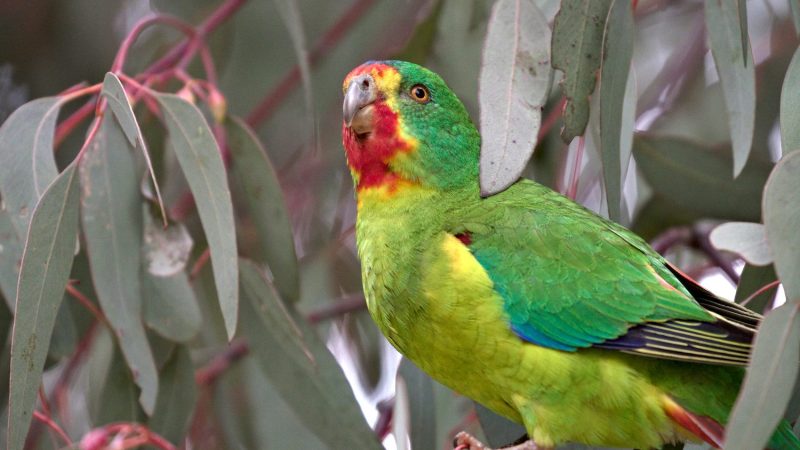
© Kevin Murray / Flickr Swift parrots are small, leprechaun-green parrots with a smudge of red and blue across their faces. They too breed in Tasmania, favoring blue gum forests. During the cooler months the parrots migrate hundreds of kilometers to the Australian mainland, where they spend the winter feeding on flowering gum trees in the south-east.
Habitat loss threatens swift parrots on both their breeding and wintering grounds. Much of their breeding habitat in Tasmania has been logged, and timber harvesting in key breeding sites continues to this day. Introduced sugar gliders (a small arboreal possum naive to the mainland) will also prey on swift parrot chicks, causing further losses. As few as 500 wild birds remain, and scientists predict that the species could become extinct within the next decade, if not sooner.

fantastic what amazing diversity we have here hope we dont blow it
I love this article, thank you!! Many migrations I did not know about.