Discover stories in Oceans
The Secret Lives of Horseshoe Crabs
Every year, horseshoe crabs emerge from the depths for one reason and one reason only: sex.
Searching for a Rare Nautilus, Round 2
Conservancy scientists (and one intrepid field reporter) take on a second search for the rare Allonautilus in the Solomon Islands. Success is contextual.

Life in the Dark: Never-Before-Photographed Sea and Cave Creatures
See never-before-photographed creatures in this preview of Danté Fenolio’s Life in the Dark.
Headhunters, Poaching, & Arson: Community Conservation in the Arnavons
After a 40-year history punctuated by arson, conflict, and poaching, conservation efforts in the Arnavon Islands are yielding a glimmer of hope for hawksbills sea turtles. Now, Conservancy scientists are working with local communities to make these critical islands the first site in the Solomon Island’s protected area network.
Unraveling the Mystery of Hawksbill Sea Turtle Migration
Join Conservancy scientists in the Arnavon Islands, where they’re tagging hawksbill sea turtles with satellite trackers to discover where and when these turtles migrate in between nesting.
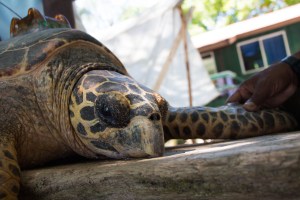
A Day in the Life of a Field Scientist: Arnavon Islands Edition
Follow science writer Justine E. Hausheer along on a typical day of scientific fieldwork in the Arnavon Islands: tagging turtles, trapping for nautilus, handlining fish, and catching crocs, all in the name of science.
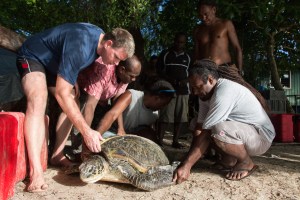
A Slaughter on Sikopo: Poaching Threatens Hawksbill Turtles in the Arnavons
Grim news on two of the tagged hawksbill turtles highlights the need for the Conservancy's investigation into the illegal hawksbill trade in the Solomon Islands.
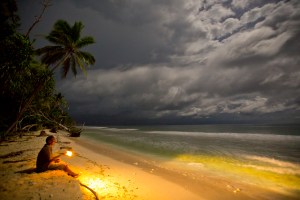
Hyperstability: The Achilles’ Heel of Data-Poor Fisheries
New research indicates that hyperstability — when catches remain high even as fish are rapidly depleted — could be a major challenge for assessing data-poor coral reef fisheries.
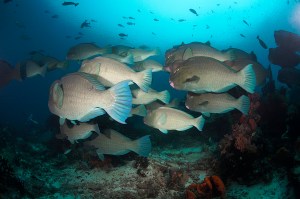
The Effectiveness, Costs and Coastal Protection Benefits of Natural and Nature-Based Defenses
A global synthesis of field measurements shows that coastal habitats – particularly coral reefs and mangroves, can be physically and economically effective at protecting coastlines.
Follow that Grouper: What Migration Data Tell Us About Locally Managed Marine Conservation
New research shows that minimal expansions to community-based protected areas in Melanesia can greatly enhance protection of fish populations.
Adventures in Alternative Energy: Giant Clam Edition
The world's largest clams may well hold the missing link to large-scale production of clean biofuels from algae.
The Path to Sustainable Fisheries is Paved with Data
The SNAPP Data-Limited Fisheries Working Group is field testing a user friendly application that puts management and science-based sustainability within the reach of small-scale and data-limited fisheries.