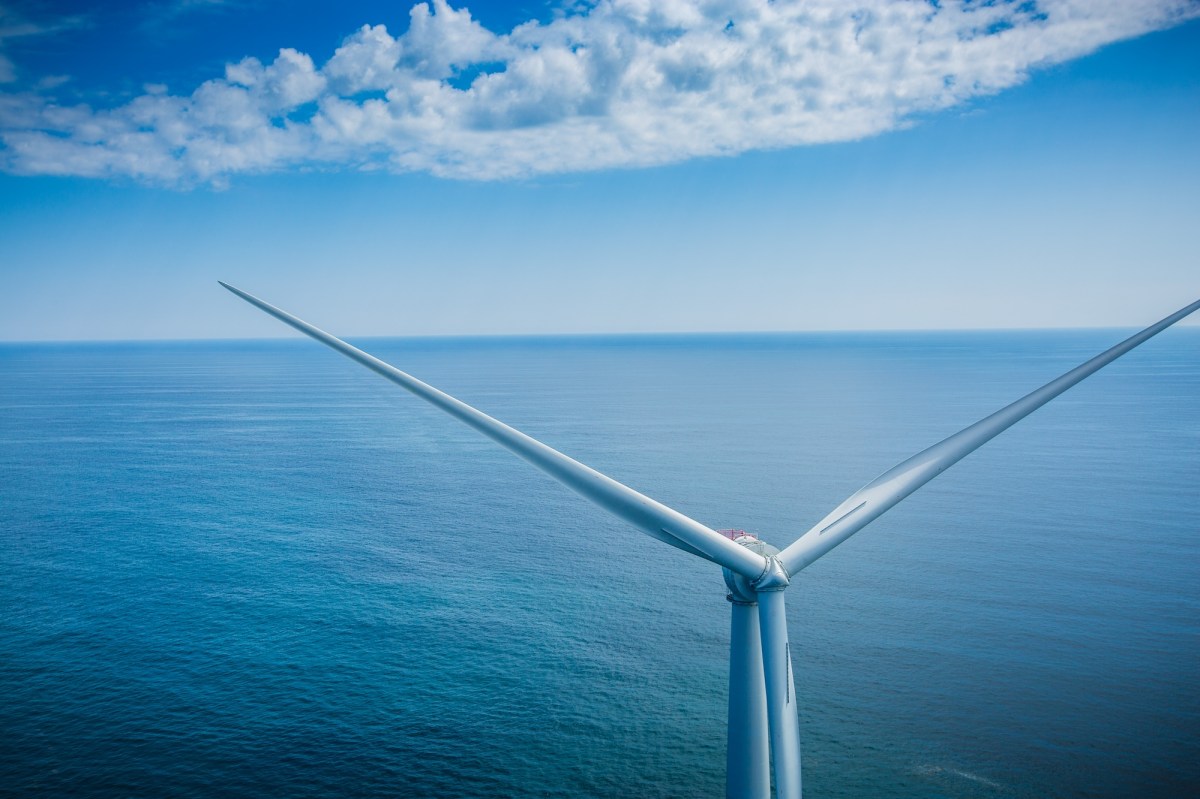
The cold waters of the North Sea off the coast of Europe once teemed with oysters. They were so numerous and harvested so readily that they became among the cheapest proteins in Europe. Now they—and the fish habitat they provided—are all but gone. A raft of NGOs and other partners, including The Nature Conservancy, are trying to change that and reintroduce an entire ecosystem. They may find opportunities in an unlikely place.
Boze Hancock, senior marine habitat restoration scientist for TNC working on the effort, tells how the burgeoning offshore wind industry of the North Sea might offer a chance to restore Europe’s native oyster.
- What did the North Sea's oyster reefs once look like?
-
We documented 4.3 million acres of oyster reef that have been removed from the North Sea. This was a really dominant structuring habitat. It drove things like fisheries on the scale of the North Sea. And there’s nothing left now. It’s all gone.
- How did that happen?
-
The serious industrial scale mining of these habitats began when steam engines went into dredge boats, and that was in the 1860s, the Dickensian era of London. There was a pushcart of oysters on [practically] every street corner in London and Amsterdam and Paris for about 100 years because they were one of the cheapest forms of protein in Europe. The dredge boats that fished out the oysters also broke up and hauled off the reef: thousands of generations of shells all glued together. They sold them to the lime kilns to burn, to make lime, to make mortar. London, Amsterdam, Paris—these cities were built on burnt oyster shell.
- So how do you begin to put it back?
-
Well, you can’t work on restoring marine habitats at a scale that’s not appropriate to the scale of the system you’re working in. Now, the offshore wind industry in the North Sea is massive. I mean, we’re talking 20 megawatts a year for the next decade. If you’re talking restoration in the North Sea, you need the scale of a partner the size of the offshore wind industry.
- What does the energy industry have to do with oysters though?
-
To put a reef back again, you first need to build a reef base out of something solid—solid enough to stay put during big storms. In the North Sea that’s rock, and that’s the expensive bit. Well, any infrastructure that touches the bottom of the North Sea has to have “scour protection” around the bottom of it.
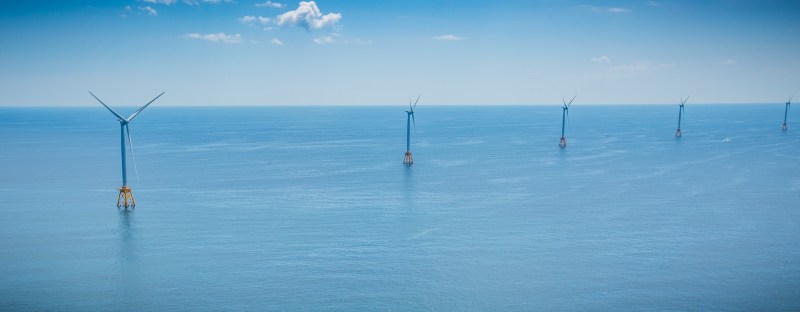
A wide view of a line of wind turbines in the ocean
- What does “scour protection” mean?
-
Think of a beach area. If there’s a rock in the sand at low tide it has a pool of water around the bottom of it. That’s because as water moves with the tide, it forms an eddy, and that eddy digs a little hole. Now, if you stick a pylon that’s big enough to hold a 7-kw turbine into the bottom of an ocean with the amount of energy of the North Sea, that hole is the kind of thing that makes engineers worried. So to stop that hole from forming, they put a meter-deep pile of rock, 30 meters diameter around the bottom of every pylon. And anywhere a cable crosses another bit of infrastructure on the bottom of the sea, they put a pile of rock a meter deep that’s the size of a football field.
- So, a potential reef base for your oysters?
-
Exactly. They are doing the expensive part for us.
- With so many wind turbines being built in the North Sea, that's a lot of potential oyster habitat. How do you begin to get oysters onto all those rocks?
-
So, with a whole stack of partners in Europe, we’ve been converting 20-foot shipping containers into big oyster larvae-setting tanks and filling them full of the rock they use for scour protection. We put 5 million oyster larvae per container in there, and we’re getting something around half to a million baby oysters setting onto that rock. Now we’re measuring how many spat do we need on rock to be able to account for [real-world loss] and still have enough oysters to do what we need.
- You’re in a sort of pilot phase right now. What happens next?
-
Last year, we placed [spat on rock] in three areas, one in the port of Rotterdam, one on a restoration site run by ARK Rewilding that is close to the coast of the Netherlands, and one in a lagoon area in Belgium. This year the plan is to deploy spat on rock onto a cable crossing.
- Wow! What’s been the biggest challenge so far?
-
A lot of the countries around the North Sea understand that the marine environment is in trouble, that the ecosystem needs help. What we’re trying to do is demonstrate a way of helping that is really constructive. There are a lot of companies that are actually quite aware of the potential and the stewardship and the eyes on them and want to do the right thing.
But it’s a matter of making the playing field even so that there isn’t one company that’s being negatively impacted because they’re trying to be good citizens. It’s a complicated policy arena.
There is also an introduced oyster disease.
- An oyster disease?
-
Yeah, the nail in the coffin for the native oyster industry in Europe was once they had fished down the stocks, they started looking for other species to prop up the industry. In the late ’70s, oysters from the west coast of the US were introduced into France, and there was an oyster disease introduced with them called bonamiosis. It doesn’t bother people at all, but it certainly bothers oysters. That spread and basically killed them off.
There are a number of estuaries where there are still populations of native oysters though. That means that that population has developed a tolerance, if you like, to the bonamia parasite. They’ve got 50 years now of natural selection for a tolerance to the parasite. If we’re not using that for restoration, we are just stupid.
But separating the parasite from the broodstock, so you’ve got the right genotype, but you’re not carrying the parasite, has been a challenge for the veterinary pathologists around Europe. We’ve got to work through that carefully and deliberately.
- If they can figure it out, what would you expect to see from restored North Sea reefs?
-
Eutrophication is one. These mitigate nutrient pollution in a way that is hard to do any other way in a marine environment. And we’re slowly starting to put back some of that structure that can re-stabilize the bottom of the North Sea. We’re also putting the habitat back that baby fish need to survive. We talk a lot about restoring oysters but it’s not the oysters themselves that are important, it’s the habitat they make for thousands of different critters.
A version of this Q&A ran in Issue 2, 2026 of Nature Conservancy magazine. Check out other stories from that issue about conservationists searching for bleach-resistant coral reefs, herpetologists tracking down super rare salamanders and the efforts of ranchers to protect the fragile frontier of the West.
Join the Discussion