Editorial photographer Greg Kahn specializes in finding the small details that reveal a larger theme in the stories that he shoots. One of his ongoing pursuits has been finding scenes and subjects that show the intersection of climate change, science, nature and people. That brought him to become fascinated with dendrochronology, which is the science of understanding a tree’s history through its rings (check out “History in the Rings,” an article in Nature Conservancy magazine ’s recent Issue 1, 2026). Through this passion project Kahn met scientists who are finding centuries of historical weather data stored inside trees. By reading the rings, and examining tree cells under microscopes, they can see evidence of rainy years, periods of drought, bug infestations, forest fires and even the aftermath of volcano eruptions.
“I end up looking at a lot of scientific papers, skimming them over, seeing if something sparks an interest,” says Kahn. He first came across a few papers on dendrochronology in 2019 and was struck by their specificity—their ability to depict events occurring in specific years. The interest stuck.
“In the last decade, there have been so many discoveries through dendrochronology,” he says. “For example, I read a paper about Genghis Khan (no relation, maybe)—they surmised he was able to extend his kingdom because of a heavy rain period visible in tree rings, which gave his forces more food and mobility. That blew my mind. We’ve all known tree rings for counting age, but now it’s taken to the next level.”
His photographic exploration of dendrochronology has taken Kahn to forests across the country that are experiencing the effects of human-made climate change: Maryland (sea-level rise), Montana (beetle infestation), Virginia (fire and biodiversity protection) and California (drought and fire). He has also visited dendrochronology labs at universities in New York and Arizona to see the deep science that unlocks the history hidden inside of trees.
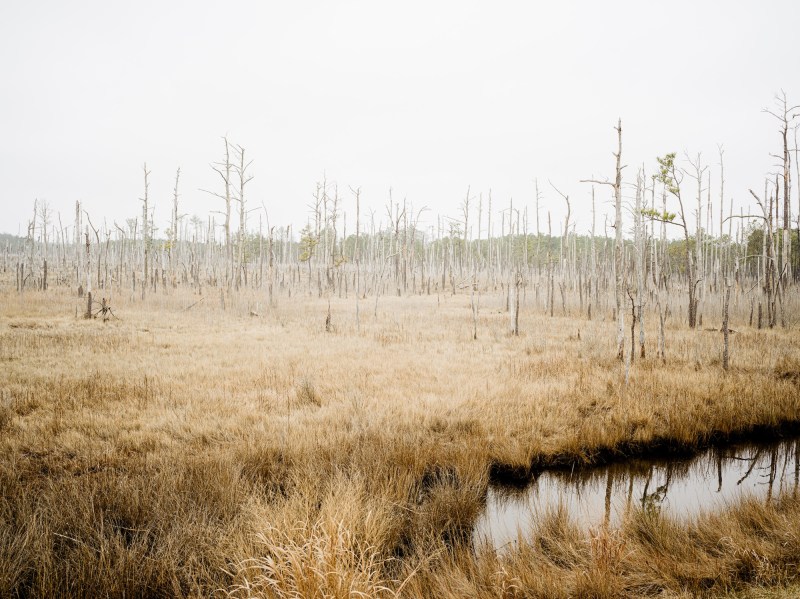
Maryland’s Eastern Shore was the first place Kahn—who is based in the Washington, D.C., metro area—visited after becoming interested in dendrochronology. “[I try to] bridge the gap between papers, charts, and data, and then show it visually in rings and real-life scenes.” With that idea in mind, a member of Maryland’s Forest Service brought him to this ghost forest of loblolly pines. As the sea level rises in the area, saltwater pushes farther upstream in these coastal areas, resulting in widespread tree die-offs and leaving behind ghostly white tree trunks. © Greg Kahn
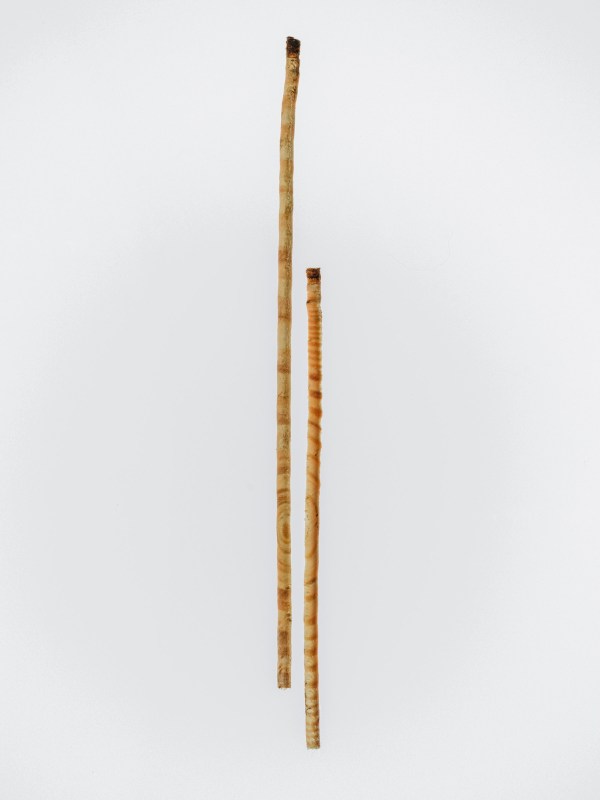
In Maryland, the state forest service worker took Kahn to a forest that had died from saltwater intrusion. The worker used a special drill to cut a thin core sample from a dead loblolly pine (seen on the right side in this photo). Then they went to a forest of healthy trees for another sample (seen on the left). The series of narrow rings in the dead tree show growth that suddenly slowed down until the tree eventually died. That gives researchers an idea of when saltwater started reaching this area. “The difference in banding and growth rings was stark—perfect for a first example,” Kahn says. © Greg Kahn
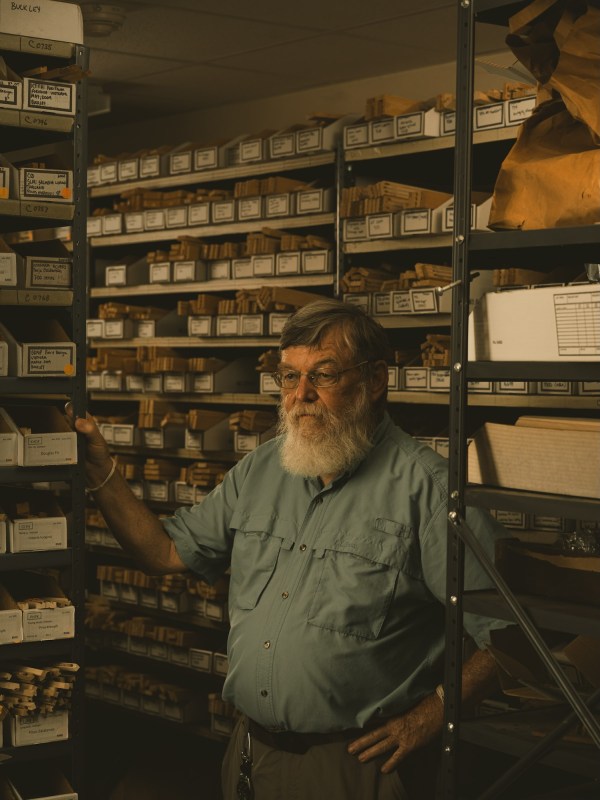
Ed Cook, a climate scientist at the Lamont-Doherty Earth Observatory out of Columbia University, stands among boxes of categorized tree cores at the center’s Tree Ring Lab. Kahn went there to understand how researchers use dendrochronology. The center, Kahn says, has thousands of samples from all over the world, many of them used to build “drought atlases.” These atlases are centuries-long records of wet and dry periods. By cross-referencing tree data like age, location and ring patterns, researchers like Cook begin to develop a view of weather activity through history and around the planet. “It was overwhelming—a microscopic to macro view,” Kahn says. © Greg Kahn
Giant sequoia cross sections fill a storage room at the Laboratory of Tree-Ring Research at the University of Arizona. The program was started in the early 1900s by Andrew Ellicott Douglass, an astronomer by training who later became the godfather of modern dendrochronology. “When I visited, it blew my mind. In the lobby, they had an entire cookie of a sequoia tree, about 15 feet tall, with rings marked for key historical events,” says Kahn. “It was humbling—this tree lived through centuries of human history.” Considered the biggest repository of tree-ring samples, the lab’s archive houses more than 2.5 miles of shelves. © Greg Kahn
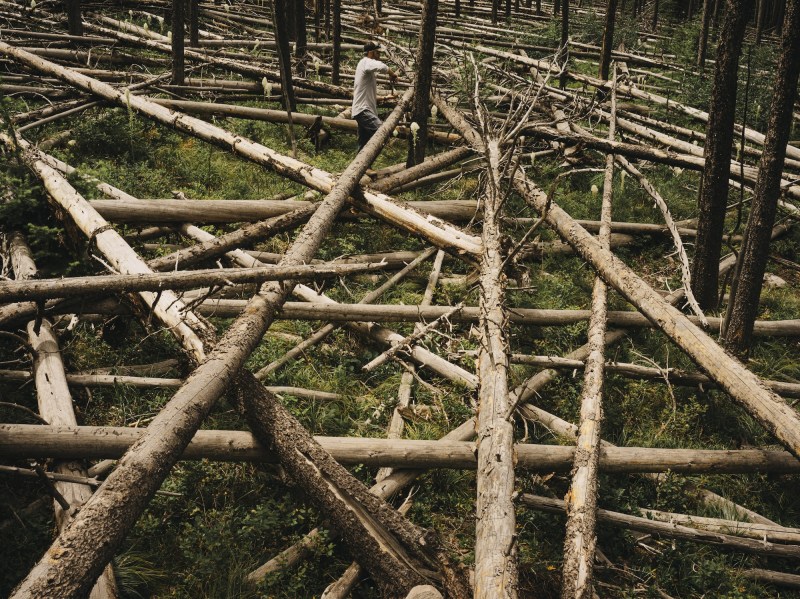
Dendrochronologist Scott Ferrenberg walks among the fallen trees in Montana’s Lubrecht Experimental Forest. Douglas fir beetles and mountain pine beetles have killed many trees in Western states. The beetle species are native to the United States, but climate change has helped to fuel infestations in previously inaccessible pine species. Drought has weakened the trees, and a warmer climate has accelerated the insects’ reproduction and allowed the beetles to expand their ranges in both elevation and latitude. © Greg Kahn
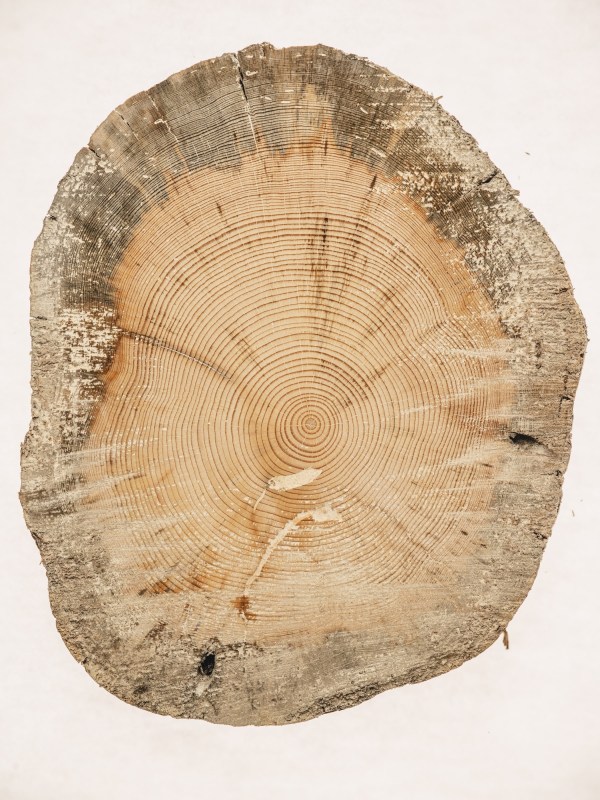
Cross sections of trees are called “cookies.” This tree cookie shows evidence of mountain pine beetle infestation in a ponderosa pine. The beetle larvae live in the tree’s inner cambium, located just beneath the bark. As the larvae bore paths through the cambium, they sever the vascular material that transports water and nutrients up and down the trunk. “You peel the dead bark and see girdle marks—parent beetles eat upward, babies eat sideways,” says Kahn. The beetles also “vector in a fungus that clogs nutrient pathways, killing trees.” That fungus creates the gray stain visible around the outer edge of this tree cutting. © Greg Kahn
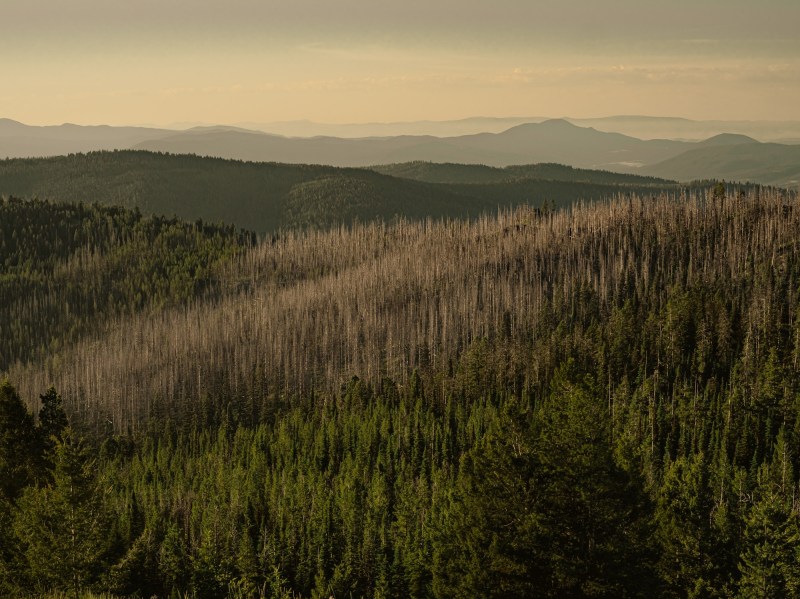
“Between 2002 and 2012, beetles did more damage than wildfires do in 100 years. Entire swaths of forest fell like matchsticks,” says Kahn. He took this aerial image of a forest in northern Montana using a drone. It shows an area affected by mountain pine beetles (center of the image). From this high vantage point, Kahn thought that the damage resembled how a forest might look after a fire moved through. Unhealthy pines cannot expel enough sap to defend against beetles; that’s why the insects thrive in areas where the trees are already stressed. © Greg Kahn
“One scientist in Arizona was doing micro-core sampling—tiny cores taken every week to track changes in a tree (over short periods of time),” says Kahn. In this type of work, samples are embedded into wax cubes, and the machine seen in this image shaves them to the width of a human hair. In this ribbon, the wood sample is the thin strip running through the center, and the curly edges are the wax. The wood shavings are dyed and mounted on slides for analysis under a microscope. © Greg Kahn
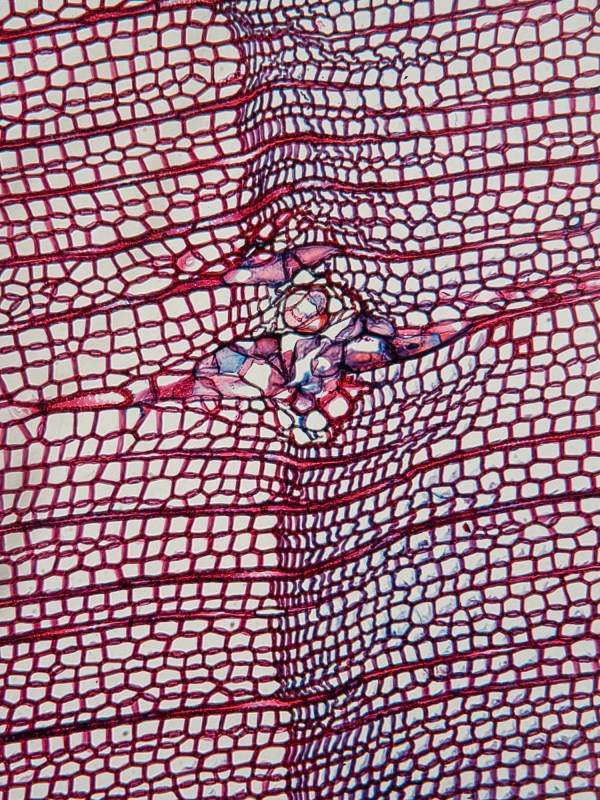
In University of Arizona’s Laboratory of Tree-Ring Research, Kahn saw how deep the information in a tree’s rings can go. This microscope image of a sample from Peru shows disruption in a tree’s cellular growth that coincides with the eruption of the volcano Huaynaputina in 1600. The narrowness of some of the cells was likely caused by cooler temperatures following the event. There were wildly recorded temperature drops around the world for a few years after the eruption, causing disruption in crops in Europe and Asia as well as a famine in Russia that led to political unrest. © Greg Kahn
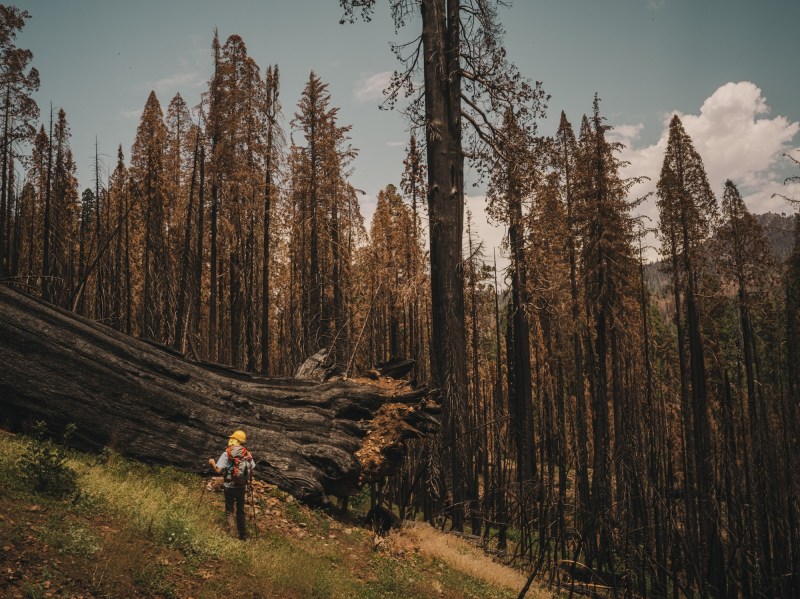
Federal forest scientist Nathan Stephenson inspects dead sequoias in Kings Canyon, California. The area has been hard hit by heat, drought and wildfires that reached into the canopy and killed many of the old-growth trees. The area they visited had been closed off to the public for safety reasons. While Kahn was visiting this dead section of forest, an ear-splitting *CRACK!* sounded about 100 yards behind the group. The entire upper portion of a sequoia had broken off and fell straight down, says Kahn. “The sequoias are massive—photos don’t do them justice. The ground trembled when [the treetop] hit…. We all kept our heads on a swivel after that.” © Greg Kahn
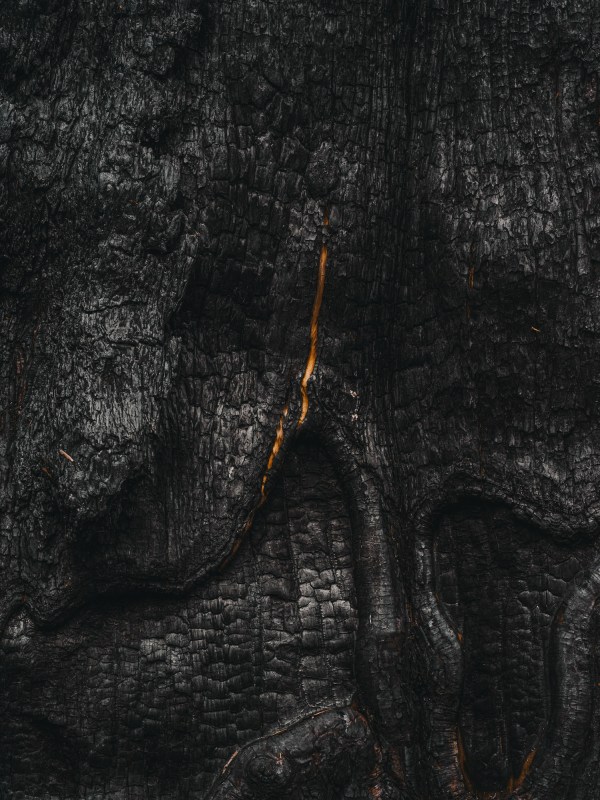
In this photo, a hint of life is evident through a charred sequoia’s trunk. “The scientists wanted to show me devastation from wildfire but also how fire is natural and helps regrowth,” says Kahn. They took him to another area in the park that had been treated in the past with controlled burns, which reduced the amount of debris on the forest floor. Those areas fared better when the megafire passed through. The scientists showed him evidence that the wildfire acted differently in the treated areas: Tree trunks were burned only close to the ground, and less damage occurred in the canopy, allowing more trees to survive. © Greg Kahn
Read more about how dendrochronology helps conservationists in the latest issue of Nature Conservancy magazine.


Do controlled burns help with the fir and pine beetles?