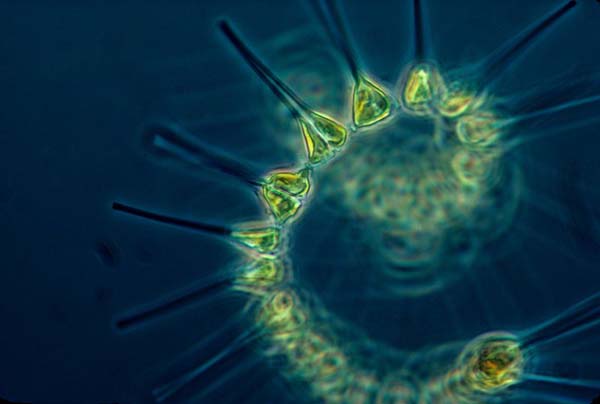
Coral bleaching, increasing storms, the loss of polar bears: many impacts of climate change are already vivid in our minds. We naturally worry about the things we can see. Huge waves and the loss of big fish and colorful corals get our attention.
But what about things we can’t see, like the tiny creatures called plankton? They are also poised for dramatic changes.
A recent dive in the sapphire waters of the Caribbean offers a close encounter with plankton. While most of my dive buddies hurry to reach the bottom, I linger as I usually do, pondering the “blue” and looking out for the visible and the invisible.
Suddenly, clouds of tiny filaments come sharply into focus. It’s blue-green algae–Trichodesmium–a type of phytoplankton that plays an important role in these nutrient-poor waters. They essentially break gaseous nitrogen’s tough triple bond and convert it into a form other phytoplankton can feed on.
What would these waters look like without them? I ponder that question as I hurry down to catch up with my dive buddies…
Phytoplankton are part of the “forests of the sea.” Microscopic organisms that account for half of all photosynthetic activity on Earth, making them responsible for much of the oxygen present in the Earth’s atmosphere.
They release great quantities of a gas (dimethyl sulfide) which changes the way clouds are formed in the atmosphere, thus ultimately influencing earth’s temperature.
Phytoplankton are also the most important part of the ocean food web. Under the right conditions of sunlight and nutrients, these tiny plants grow and multiply, becoming food for the other kinds of plankton, known as zooplankton (animal plankton).
Zooplankton are in turn food for larger animals in the ocean. Scallops filter plankton from the water. Squid eat small fish which eat plankton, as do humpback whales. Higher on the food chain, sharks eat fish, which eat smaller fish, which eat—you guessed it– plankton.
Without plankton small fish would starve, and without small fish, so would large fish. Ultimately, nearly everything in the ocean somehow depends on phytoplankton.
What happens to phytoplankton when ocean conditions change? A recent study in the journal Science (Thomas et al, 2012) reports that a warming ocean will alter the productivity and composition of marine phytoplankton communities–particularly tropical communities–leading to phytoplankton biodiversity declines and shifts in species ranges.
For example, a mean temperature change on a reef of only ~2°C could lead to the loss of approximately a third of contemporary tropical strains by 2100.
The authors suggest that previous predictions for phytoplankton may have underestimated the impacts that warming will have on these creatures — which also means the impacts climate will have on our air and food.
Plankton may not be as charismatic as polar bears, but we’ll feel actually the loss of these tiny organisms even more dramatically than the loss of the bears.
We may not be able to see them, but let’s not be blindsided by their disappearance. Our chance of effectively adapting to climate change will depend on our understanding of these and other seemingly invisible ocean impacts.
Reference: Thomas, M.K., C.T. Kremer, C.A. Klausmeier, & E. Litchman. 2012. A global pattern of thermal adaptation in marine phytoplankton. Science DOI: 10.1126/science.1224836
(Photo: Phytoplankton. Credit: National Oceanic and Atmospheric Administration).
Opinions expressed on Cool Green Science and in any corresponding comments are the personal opinions of the original authors and do not necessarily reflect the views of The Nature Conservancy.
Join the Discussion
1 comment